Several
years ago a well known
professional coin dealer
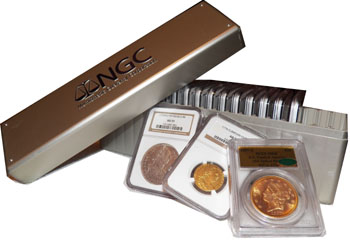
proposed the idea of putting
together a Box of Twenty
key coins as vehicle for
good potential in the
future. Twenty coins spread
over different series
are diversified enough
so that if one does not
perform well, the others
can make up the difference.
It’s well known
that not all rare coins
appreciate in value at
the same time. Some remain
dormant, some depreciate
in value, some increase
modestly, and some rocket
into the stratosphere.
Wouldn’t it be great
if we knew the rockets
in advance? Since we only
know them in retrospect,
it makes sense to choose
a group of pieces that
are fundamentally or conditionally
rare so that any downside
risk is outweighed by
the upward movement of
a few of the superstars
in the group. Now is an
excellent time to compile
your Box of Twenty.
One
compelling reason to get
started is that on October
31st it was announced that
four new rare coin investment
funds will be formed by
a management company that
will add $250 million to
the rare coin market. It
is believed that this infusion
of new investment capital
will encourage the market
to reach new levels. It
has also been speculated
that the presence of institutional
investors will allow individual
rare coins to break the
$10 million barrier.
A
fundamentally rare coin
is one that had a very limited
mintage. All regularly issued
business strike and proof
coins with mintages under
10,000 pieces are fundamentally
rare in any condition obtainable.
This category includes all
early gold and silver coinage
as well as some copper and
nickel pieces. For example
all of the quarter eagles
of 1796 to 1807 are in this
category. The largest mintage
was in 1807 with 6,812 pieces.
Both PCGS and NGC have certified
254 pieces in all grades,
and these numbers do not
account for crossovers or
resubmissions. Obviously
no more than 254 collectors
could have one of these
certified coins, making
them always in demand. Yet
mintages of other years
are significantly lower.
The next highest, 1804,
is less than half at 3,327.
Both services have 147 combined
including both 13-Star and
14-Star reverses. All early
date quarter eagles are
fundamentally rare and would
make an excellent choice
for a box of twenty.
A
conditionally rare coin
is one that has a large
mintage but saw much circulation
and is common in circulated
grades but rare in uncirculated
or almost uncirculated condition.
An example is the 1861 half
eagle. It had a mintage
of 688,084, making it a
fairly common date. In circulated
grades it retails for less
than $600. Yet in Mint State
65 it lists for $37,050
and in MS66 a whopping $71,500.
Clearly upper mint state
grades of this coin are
desirable because they are
conditionally rare. NGC
has certified 1456 in total
but only 8 in MS65 and 2
in MS66. PCGS has 715 in
total with 7 in MS65 and
1 in MS66. While these examples
are sufficient to make the
point, there are numerous
other examples one could
choose.
Some
coins appreciate slowly
in value and others jump
up quickly. For example,
the 1860-O silver dollar
increased from $5,560 to
$6,940 since July 2005;
however, if we look at the
1860-O in MS65, we see an
increase from $16,880 to
$35,930 in that same period
of time.
The
foregoing are isolated examples
of the kinds of changes in
value that quality selected
coins can undergo over time,
and these examples are taken
only over the past five years.
Of course they do not include
the influence of the new coin
investment funds. A box of
twenty well chosen pieces
held over time will yield
some spectacular results,
and the time to begin with
your twenty might never be
better than it is now.























 A
fundamentally rare coin
is one that had a very limited
mintage. All regularly issued
business strike and proof
coins with mintages under
10,000 pieces are fundamentally
rare in any condition obtainable.
This category includes all
early gold and silver coinage
as well as some copper and
nickel pieces. For example
all of the quarter eagles
of 1796 to 1807 are in this
category. The largest mintage
was in 1807 with 6,812 pieces.
Both PCGS and NGC have certified
254 pieces in all grades,
and these numbers do not
account for crossovers or
resubmissions. Obviously
no more than 254 collectors
could have one of these
certified coins, making
them always in demand. Yet
mintages of other years
are significantly lower.
The next highest, 1804,
is less than half at 3,327.
Both services have 147 combined
including both 13-Star and
14-Star reverses. All early
date quarter eagles are
fundamentally rare and would
make an excellent choice
for a box of twenty.
A
fundamentally rare coin
is one that had a very limited
mintage. All regularly issued
business strike and proof
coins with mintages under
10,000 pieces are fundamentally
rare in any condition obtainable.
This category includes all
early gold and silver coinage
as well as some copper and
nickel pieces. For example
all of the quarter eagles
of 1796 to 1807 are in this
category. The largest mintage
was in 1807 with 6,812 pieces.
Both PCGS and NGC have certified
254 pieces in all grades,
and these numbers do not
account for crossovers or
resubmissions. Obviously
no more than 254 collectors
could have one of these
certified coins, making
them always in demand. Yet
mintages of other years
are significantly lower.
The next highest, 1804,
is less than half at 3,327.
Both services have 147 combined
including both 13-Star and
14-Star reverses. All early
date quarter eagles are
fundamentally rare and would
make an excellent choice
for a box of twenty.

