Coin
collecting in the United States became popular almost as soon
as coins were first made. Although many of the early collectors
were Englishmen, some of the founders of U.S. numismatics
include Lonin G. Parmelee, Harold P. Newland and T. Harrison
Garrett whose incredible collection was sold around the time
the principle of U.S. Rare Coin Investments was making efforts
at turning his own hobby into a profession in the 1970's.
Today, rare coins are considered sound investments and in
fact have been featured numerous times in the Wall Street
Journal, Barron's, Money Magazine, on CNBC, and numerous other
financial publications. Investment professionals from Harry
Browne to independent financial planners have recommended
some portion of one's investment portfolio to contain precious
metals and rare gold and silver coins. Some
suggest as much as 25% of one's overall wealth be placed in
a position of rare coins and precious metals. In other
words, rare coins have been no secret to those "in the know".
Informed investors have long considered coins not only as
a means for capital appreciation, but also as a way to secure
long term retirement goals, establish a confidential low key
way of protecting their own investment assets to balance out
the fluctuations in dollar related portions of their holdings
and to enjoy owning something they have learned that over
time, would stay in demand, hence providing safety as well
as possibly spotting and owing certain rare coins that have
been for the most part undervalued, and subsequently realizing
a higher demand thereby showing great profits when sold down
the road.
Investing
in rare coins up till the new wave of fresh investment dollars
coming into the industry recently, was considered a long-term
investment. Frankly, the investor should consider this approach
as a means to a more diversified portfolio. Too often in the
past, unskilled investors equated portfolios with stocks and
bonds. However as seasoned investors have seen and as the
modern portfolio theory has suggested, one should strongly
consider investing in assets that can have a counter effect
to the dollar and most other dollar related (and reported)
securities. This approach "spreads out" one's portfolio and
reduces risk. Take for example one who purchased gold, silver,
rare coins and other forms of hard assets using this approach
as well as a means to hedge against weakening trends in currency
and securities markets. Even if the dollar related securities
portion of the portfolio didn't perform well, the overall
portfolio generally reacted favorably due to this diversification.
We at U.S. Rare Coin Investments
have been involved in the research, trading and financial
aspects of rare coins and gold and silver, precious metals
for decades. We feel that especially now, in today's atmosphere
of uncertainty in the global economic climate, as well as
changes in the US financial markets with regard to a variety
of reasons, from uncertain tax consequences and changes, increasing
reliance on foreign manufactured products, the seeming instability
and somewhat wild fluctuations in the stock markets as well
as what would appear to be a bottoming of interest rates,
that today may represent one of the true
windows of opportunity for beginning the formation
of a rare coin investment portfolio, as well as the recommendations
to those who are already involved and have a position in rare
coins to take a more aggressive posture.
Those who have coins, whether
purchased or inherited should seek out expert advice now,
and formulate an intelligent financial plan in which to capitalize
on these changes in the economic atmosphere, thereby securing
a more profitable and secure future in their own lives and
the well being of their families.
Relationships we have built
over many years in the trade, as well as a strong following
with collectors and investors which include some of America's
most wealthy families gives us the "inner circle edge" when
it comes to helping you sell your valuables, or as you begin
or evolve into the deeper facets of the rare coin business
as many can attest. Our abilities and representation stretches
on several continents through personal relationships, affiliations
and expert inside representation. Please read more in our
services section to see what we can do for you in this wonderful
world of rare coins and tangible assets.
Set Building as an
Investment Tool
One of the most rewarding
investment strategies is building sets of rare coin series.
Rare coins have historically done well in both bull and
bear markets. Substantial long-term profits have been made
by coin collectors because rare coins have shown high rates
of appreciation.
Collectors have an advantage
because while high profits may not be their primary motivation
to obtain rare coins, they are able to limit their scope
and concentrate on one area of collecting. If they have
a plan that allows them to collect coins with proven rarity
in an orderly fashion, they are in a position to reap strong
rewards down the road.
Often sets of coins are
more liquid than a group of unrelated coins. In many instances,
the whole is greater than the sum of its parts. Successful
set building is a function of both rarity and condition,
which enable the collector/investor to determine his or
her comfort level.
Since its inception U.S.
Rare Coin Investments has assisted collectors/investors
in assembling investment grade sets of rare coins. We continue
to offer the following services:
We help you to find an area of interest
that would make a suitable investment
Together we develop a strategy
Your goals are transformed into a “want-list”
Our expert buyers find the right pieces
to meet your needs
We contact you as soon as we have located
suitable pieces for your collection/investment
We work with you step by step.
No coins are sent without your approval in advance. You have
total control over your collection/investment by using these
services provided by US Rare Coin Investments.
Call Phone 1-800-388-8118
for more information.
Collecting
and Investing in Sets
Sets of rare coins have long
been recognized an excellent storehouse of value and a useful
component to an investment portfolio. In addition to having
an opportunity to collect valuable and authentic artifacts
from the past, rare coin sets can be a method of adding diversification
to the precious metals portion of a portfolio. Often the people
who start out as collectors become investors, and investors
become interested in coins’ histories. Excellent rare
coin collections are also excellent investment portfolios.
How to build a set Sets are comprised of the dates and mintmarks in
a series. For example one could assemble a set of gold dollars.
It would consist of one piece for each date and mint in the
series. Another way to collect is by assembling a Type Set.
Such a set would include one example of a certain design in
a group of coins. For example one could assemble a Type Set
of gold coins. One piece in that set would be a gold dollar;
another would be a half eagle, and so on. Of course, there
are other strategies. Some enjoy collecting an example of
each type by a certain designer or an historical period of
time. Others collect coins by die variety. A famous collection
consisted of all the die varieties of 1794 Large Cents. Some
collect by mintmark. Carson City coins as an area of concentration
has been very popular. Some collect the first and last date
of a series. There are no rules here, only your interests.
Sets as Collectible Sets of rare coins should be chosen with care and
assembled with the following in mind:
Have a strategy which includes acquisition
and liquidation
Purchase coins over a period of years
Be prepared to hold them for the long
term
When the opportunity presents itself,
be prepared to liquidate them
Sets as Investments Coin sets can be a wise choice for maximizing your
return on investment. The individual pieces are often less
valuable than the collection is as a whole. When assembling
a set, choose the best quality coins that will enable you
to meet your investment goals. Follow the same steps as a
collector in assembling your sets of coins.
How to Start Call Phone 1-800-388-8118 or Email
us for more information on recommended sets of rare coins.
Introduction to Coin
Collecting
In the 1500’s among the interests of wealthy Europeans
was coin collecting. They were interested in Ancient coins
for their rarity and historical value. Coin collecting became
a prestigious hobby. By the end of the century coin collecting
became popular among the nobility. During this time the first
coin catalog was written, and the first coin auction took
place in Holland.
Since then rare coin collecting
has become extremely popular. Politicians, entertainers, and
ordinary people have been and are enthusiastic collectors.
Today worldwide there are perhaps 50 million coin collectors.
In the U.S there are 7 to 10 million. As a hobby, coin collecting
is wide spread and diverse.
Great museums of the world
are places where some famous collections are found. These
include the Metropolitan Museum of Art, the Smithsonian Institution,
and great museums in the major capitals of the world.
The range of collecting is
enormous. One can collect anything from Ancient coins to a
modern mint’s products. There are no rights or wrongs
as to what to collect. The choice is with the individual.
How is a coin’s
value determined?
Value is determined by the marketplace. Condition, demand,
and rarity are the three factors that act in combination to
allow the value to be established.
Condition
Most United States coins were issued for and saw circulation.
Many were mistreated or just used in commerce, making them
undesirable for numismatic value. A few exceptions are colonial
coins; early coppers, which are half-cents and large cents;
early silver and rare gold coins. These are for the most part
unobtainable in uncirculated condition at any price. However,
the Almost Uncirculated grades of AU50 to AU58 are possible
for many of these issues.
Mint state and proof coins
are two different categories. The former consists of pieces
that were manufactured for circulation that never were circulated.
They are rated in 11 grades from MS60 to MS70. These measures
of a coin’s state of preservation often depend on very
small differences from one grade to another. Proof coins were
not meant to circulate. They were specially struck on specially
polished planchets and received careful handling. Many, especially
modern proofs, were made for the collector market.
The appeal of a coin is determined
by a number of factors including its design, color, strike,
luster, and the absence of wear or distracting marks. All
of these affect the coin’s beauty and can attract investors
and collectors increasing the demand for the set in which
the coin is found.
Demand
The demand for a particular issue comes from collectors who
want or need the coin to complete a set. It also comes from
investors who want to sell their coins at the appropriate
time to make a profit. Various factors influence demand. These
include provenance, historical significance, and prior market
success.
Rarity
Coins are either rare in absolute terms or conditionally rare.
A fundamentally rare coin has a low mintage. If fewer than
1000 pieces were minted, no more than that number of collectors
can own the issue making it fundamentally rare. Other coins
have large mintages, but are rare in higher conditions. Perhaps
they were not saved when issued or they were poorly struck
and wore quickly. Because scarcer issues are more desirable,
they are more difficult to obtain and their prices are higher
than common coins.
Call Phone 1-800-388-8118
for more information or Email
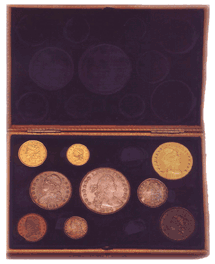
Investing in Coins - Coin
Investing - Investing in Gold Coins - Box
of Twenty Coins
























 Coin
collecting in the United States became popular almost as soon
as coins were first made. Although many of the early collectors
were Englishmen, some of the founders of U.S. numismatics
include Lonin G. Parmelee, Harold P. Newland and T. Harrison
Garrett whose incredible collection was sold around the time
the principle of U.S. Rare Coin Investments was making efforts
at turning his own hobby into a profession in the 1970's.
Coin
collecting in the United States became popular almost as soon
as coins were first made. Although many of the early collectors
were Englishmen, some of the founders of U.S. numismatics
include Lonin G. Parmelee, Harold P. Newland and T. Harrison
Garrett whose incredible collection was sold around the time
the principle of U.S. Rare Coin Investments was making efforts
at turning his own hobby into a profession in the 1970's. Investing
in rare coins up till the new wave of fresh investment dollars
coming into the industry recently, was considered a long-term
investment. Frankly, the investor should consider this approach
as a means to a more diversified portfolio. Too often in the
past, unskilled investors equated portfolios with stocks and
bonds. However as seasoned investors have seen and as the
modern portfolio theory has suggested, one should strongly
consider investing in assets that can have a counter effect
to the dollar and most other dollar related (and reported)
securities. This approach "spreads out" one's portfolio and
reduces risk. Take for example one who purchased gold, silver,
rare coins and other forms of hard assets using this approach
as well as a means to hedge against weakening trends in currency
and securities markets. Even if the dollar related securities
portion of the portfolio didn't perform well, the overall
portfolio generally reacted favorably due to this diversification.
Investing
in rare coins up till the new wave of fresh investment dollars
coming into the industry recently, was considered a long-term
investment. Frankly, the investor should consider this approach
as a means to a more diversified portfolio. Too often in the
past, unskilled investors equated portfolios with stocks and
bonds. However as seasoned investors have seen and as the
modern portfolio theory has suggested, one should strongly
consider investing in assets that can have a counter effect
to the dollar and most other dollar related (and reported)
securities. This approach "spreads out" one's portfolio and
reduces risk. Take for example one who purchased gold, silver,
rare coins and other forms of hard assets using this approach
as well as a means to hedge against weakening trends in currency
and securities markets. Even if the dollar related securities
portion of the portfolio didn't perform well, the overall
portfolio generally reacted favorably due to this diversification.